
Polk County Arrest Records and Charges
Polk County arrest records begin with the law-enforcement event. They can involve the Polk County Sheriff's Office, Tryon Police Department, Saluda Police Department, North Carolina Highway Patrol, probation and parole officers, wildlife officers, or another agency that appears in Citizen Connect filters. The arrest side may show an arrest search result, an incident record, booking or confinement context, an arresting agency, dates, and charges as listed by the Sheriff portal.
Court charges after arrest are the allegations that enter the judicial process. A charge can appear through a warrant, citation, criminal summons, magistrate's order, indictment, or information. Once filed, the charge is tracked in the court case through hearings, amendments, dismissals, pleas, disposition, and sentencing. For the full case file and outcome, use Polk County criminal court records. For current custody and jail roster details, use the inmate search route.
Search Polk County Arrest Records
The official Sheriff-linked public tools are in Citizen Connect. The Citizen Connect Arrest Search is a free public search by date range. The Citizen Connect Incident Search supports incident number, date range, name, and location fields. The Sheriff detention page also links current inmate confinements, which can be useful when an arrest led to current custody.
| Tool | Search Fields | Best Use |
|---|---|---|
| Arrest Search | Date range | Find arrest entries in the Sheriff Citizen Connect arrest index. |
| Incident Search | Incident number, date range, name, location | Find incident records that may relate to an arrest or charge event. |
| Inmate Confinements | Current confinements, admits by date range, charges, arresting agency | Check current custody or recent admit context. |
| Citizen Connect App | App features include tips, incident report submission, outstanding criminal papers, and public safety information | Use for Sheriff public-safety tools that may not be obvious in the static web navigation. |
The source image below is the Polk County Citizen Connect Arrest Search, the official Sheriff-linked arrest records search path captured in the manifest.
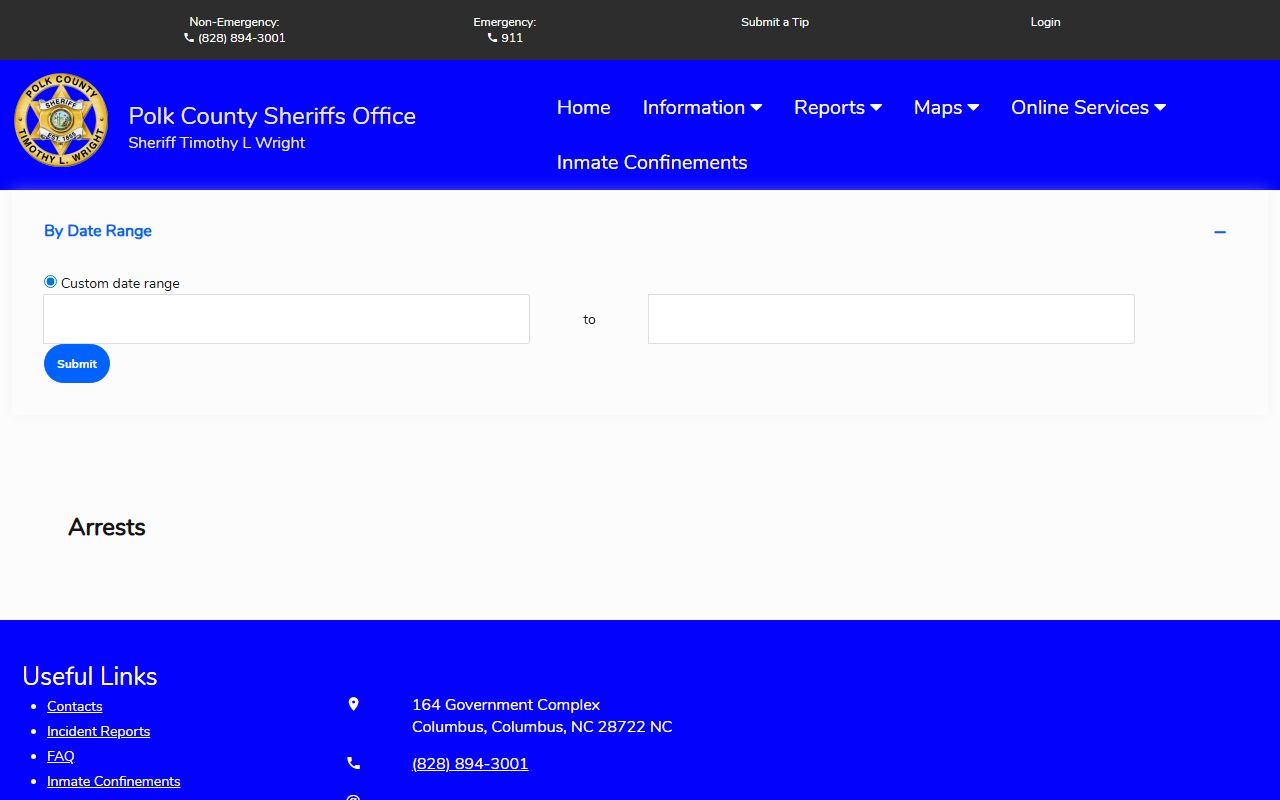
Arrest Search gives a law-enforcement entry point, while court case lookup is still needed to see how charges were filed and resolved.
Incident Records and Arrest Context
Incident records can help connect an arrest to the event reported by law enforcement, but they are not the same as a criminal court charge. A single incident may lead to no arrest, one arrest, several arrests, or charges that later change. The research identifies the Citizen Connect incident search fields as incident number, date range, name, and location. Criminal investigation records may be limited by North Carolina law, so the public incident view should not be treated as the full investigative file.
The image below is sourced from Polk County Citizen Connect Incident Search, another Sheriff public-record access point tied to arrest records and charge context.
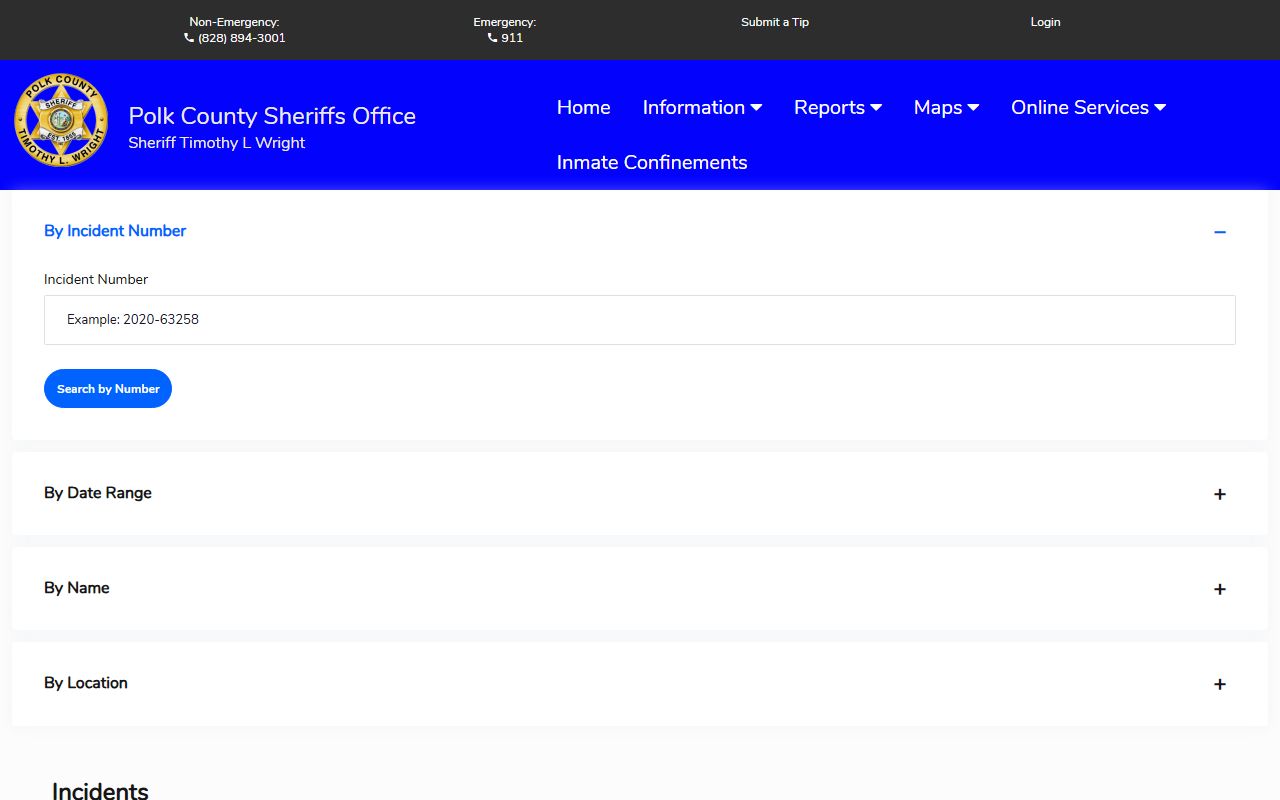
Incident lookup can support an arrest records search, but the court charge record must be checked in eCourts or through the clerk.
Court Charges After Arrest
After an arrest, the formal court charge may reach the file through more than one document type. North Carolina criminal files can include warrants, magistrate orders, citations, criminal summonses, indictments, and informations. The document matters because it shows who initiated the charge and where the case is likely to proceed. Felony matters may start in District Court but move to Superior Court for indictment, plea, trial, or sentencing.
| Charging Document | Who Uses It | What It Means in Polk County |
|---|---|---|
| Complaint / Citation / Magistrate Order | Officer, magistrate, or court process | Often tied to initial District Court proceedings, infractions, misdemeanors, or first felony steps. |
| Information | Prosecutor | A prosecutor-filed charging document used in some Superior Court criminal cases. |
| Indictment | Grand jury | A felony charging document that commonly moves the charge into Superior Court prosecution. |
Andrew Murray is the District Attorney for Prosecutorial District 42, which covers Henderson, Polk, and Transylvania Counties. The District Attorney decides whether to proceed, dismiss, reduce, amend, negotiate, or seek indictment in many criminal matters. The image below is sourced from the official Prosecutorial District 42 District Attorney page.
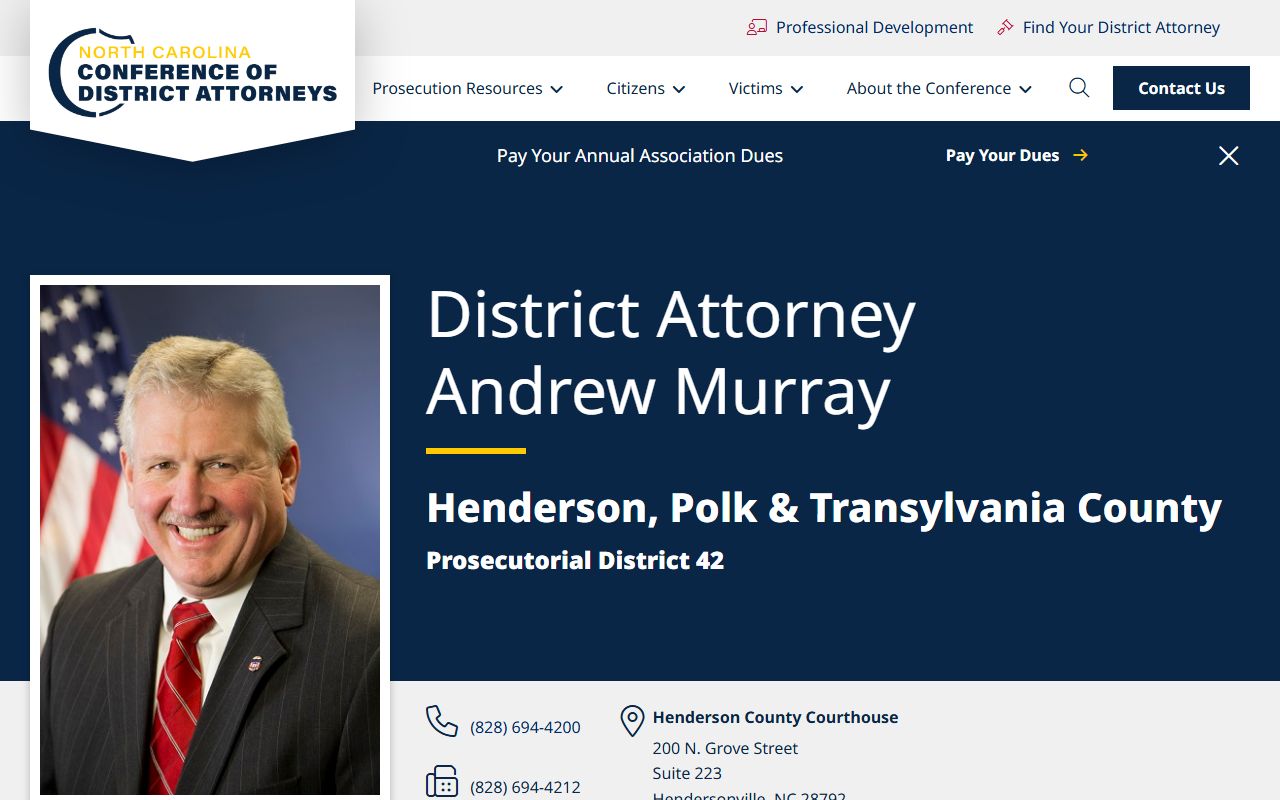
The DA source helps explain why an arrest charge can later be amended, reduced, dismissed, or replaced by a different formal court charge.
Polk Charge Status Terms
Charge status changes are common. An arrest entry may list the first charge, but the court record can later show a new status. One count may be dismissed while another count ends in a plea. A felony may move from District Court to Superior Court. A charge may be amended or reduced as part of a plea. Always read the charge line with the disposition and judgment fields, not in isolation.
| Status | What It Means |
|---|---|
| Pending | The charge remains open and has not reached final disposition. |
| Amended | The charge was changed after filing, often by correction, plea agreement, or prosecution action. |
| Reduced | The charge moved to a lower offense level or lesser offense. |
| Dismissed | The charge ended without a conviction on that count. |
| Disposed | The court entered an outcome such as guilty, not guilty, dismissed, judgment, or other final result. |
| Expunged | The record may be removed from public access after the required order and agency processing. |
Charges vs Convictions
Polk County arrest records and charge records do not prove conviction by themselves. A person can be arrested and never convicted. A charge can be dismissed, reduced, or amended. A conviction appears only after a guilty plea, verdict, or other finding that results in guilt or responsibility. This distinction is central when reading court charges after arrest.
| Point | Charge | Conviction |
|---|---|---|
| Legal Meaning | An allegation that an offense occurred. | A court outcome based on plea, verdict, or judgment. |
| Where It Appears | Arrest search, booking context, warrant, citation, indictment, information, and court case entry. | Disposition, judgment, sentence, probation, fine, cost, or criminal history result. |
| Can Change | Yes, it can be amended, reduced, dismissed, or replaced. | Can be appealed, corrected, or in some cases expunged if eligible. |
| Best Check | Review charge status and related docket entries. | Review disposition, sentence, and final judgment. |
Statewide Charge Checks
Statewide tools serve different needs. NC eCourts Portal is the court case and hearing path. The North Carolina Department of Adult Correction offender search is for state prison offenders, probationers, parolees, and historical correctional data, not every arrest. The NC State Bureau of Investigation sex offender registry is a separate registry for reportable sex offenses. These state tools should not be treated as replacements for Polk County court charges or Sheriff arrest search.
The image below is sourced from the North Carolina SBI sex offender registry, a statewide registry that may relate to some convictions but does not show every Polk County arrest record or charge.
The registry is included as a statewide check, but regular court charge records must still be read through the court file.
Sealed and Expunged Charges
North Carolina law limits some arrest and charge information. Juvenile matters are generally confidential. Sealed court records are restricted by law or order. Expunged charges or convictions are removed from public access after the correct petition, review, order, and agency processing. A dismissed charge does not automatically disappear from public view, and a visible arrest record does not prove the final court outcome.
| Point | Sealed | Expunged |
|---|---|---|
| Public Access | Hidden or limited for ordinary public users. | Removed from public access after a qualifying court order. |
| Record Status | The record may still exist with limited access. | The public record is treated under expunction law after processing. |
| Common Sources | Juvenile, mental health, protected-party, or court-ordered restrictions. | Dismissals, not-guilty outcomes, and some eligible convictions, depending on statute. |
| Where to Start | Clerk of Superior Court or legal counsel for access questions. | NC Judicial Branch expunction forms and the proper clerk filing route. |
Limits on Arrest Records
Law-enforcement records are not the same as court records. G.S. 132-1.4 treats criminal investigation and intelligence records differently from ordinary public records. The Sheriff may make certain arrest, incident, and custody information public through Citizen Connect, but that does not mean the full investigative file, witness details, protected victim information, or sealed material is public. For a court charge, use Portal and the Clerk of Superior Court. For arrest or incident records, use the Sheriff channel.
Polk County Sheriff Timothy L. Wright's office is at the Law Enforcement Center, 164 Government Complex Drive, Columbus, NC 28722. The Sheriff phone is (828) 894-3001, with after-hours non-emergency contact at (828) 894-0188. The District Attorney contact listed by the court directory is (828) 894-4910, and the Clerk of Superior Court contact is (828) 894-4900. Use the office that holds the record type sought.