
Polk County Criminal Court Records
A criminal court record is the court's case file, not the arrest event by itself. In Polk County, the Clerk of Superior Court maintains criminal files, dockets, indexes, judgments, and related records under the North Carolina court system. The file can begin with a citation, warrant, magistrate order, criminal summons, indictment, or other charging paper, then grow as hearings, motions, pleas, dismissals, judgments, and sentence terms are entered.
District Court handles misdemeanors, infractions, traffic offenses, initial felony proceedings, and many first appearances. Superior Court handles felony trials and felony dispositions after indictment or other Superior Court charging route. Polk County is in Superior Court District 42, District Court District 42, and Prosecutorial District 42. The District Attorney for Prosecutorial District 42 handles state criminal prosecution for Henderson, Polk, and Transylvania Counties.
For a focused explanation of the arrest-to-charge layer, use Polk County arrest records and court charges. The criminal court file is broader because it tracks the case through disposition and sentence.
Search Polk County Criminal Records
The main public lookup route is NC eCourts Smart Search. Search by case number when possible. If the case number is not known, search by defendant name and use Advanced Filtering Options to limit location to Polk County and narrow case type, status, file dates, and party criteria. Search Hearings is used for upcoming criminal court dates, while the Clerk of Superior Court is used for full files, paper records, certified copies, and older materials that are not complete online.
- Open NC eCourts Portal and select Smart Search for case information.
- Search by criminal case number or defendant name.
- Filter by Polk County and refine by case type, status, or filing date.
- Open the public case result and review charges, docket events, hearings, disposition, and financial fields.
- Use Search Hearings when the question is the next court date or courtroom.
- Request clerk copies when a certified judgment, full paper file, or document copy is required.
The image below is sourced from the NC Judicial Branch expunction help topic, which is directly relevant to Polk County criminal court records that may later be removed from public access.
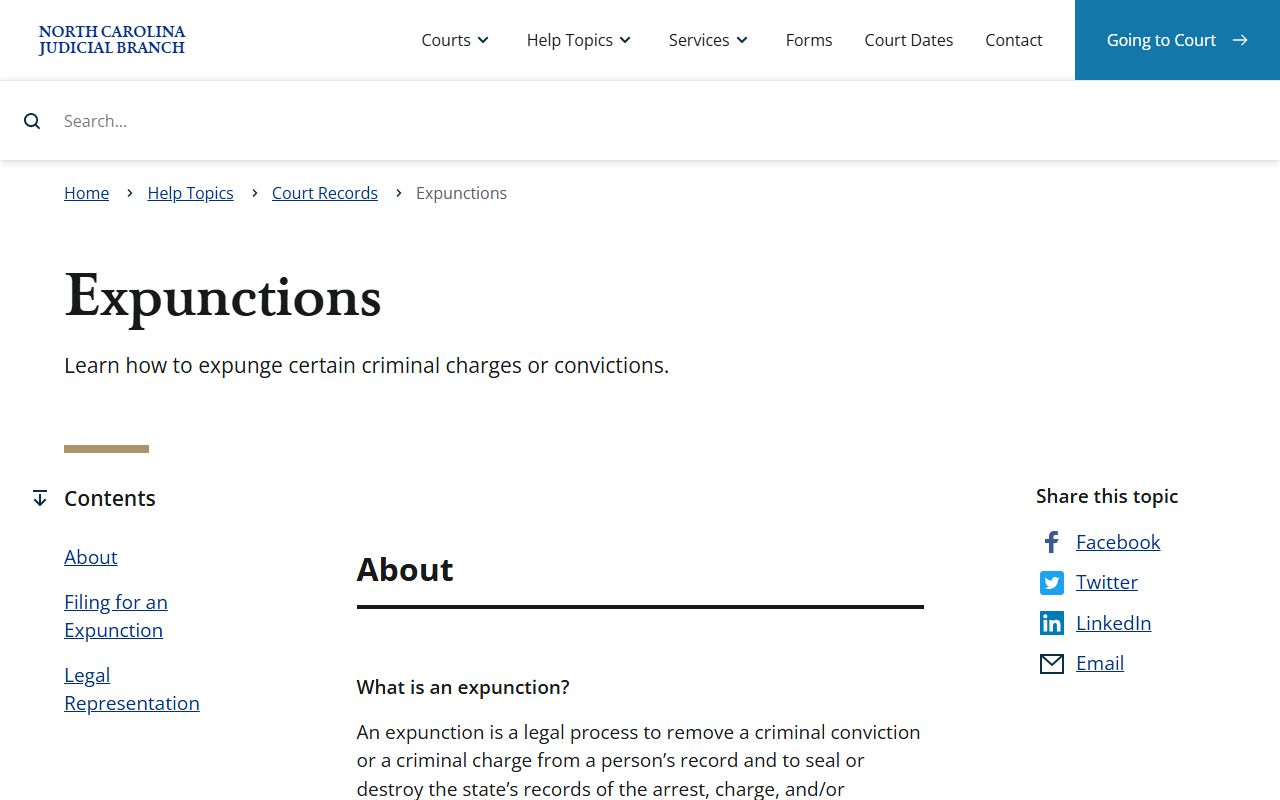
Expunction guidance is important because dismissed charges, not-guilty outcomes, and some convictions may follow different public-access paths after a court order.
Polk County Criminal Case Flow
A criminal case record changes as the matter moves through the court. Early entries may show charges, process, an initial appearance, bond or release conditions, and a first court date. Later entries can show arraignment activity, motions, continuances, plea settings, trial settings, dismissal, conviction, judgment, sentencing, probation, fines, costs, restitution, or appeal. A single defendant can have several charges in one case, and each charge can end differently.
Case flow: Charges Filed › Arraignment › Pretrial / Motions › Plea or Trial › Disposition › Sentencing
| Stage | What Happens in the Record |
|---|---|
| Charges Filed | The offense allegations appear through citation, warrant, summons, magistrate order, indictment, or information. |
| Arraignment | The court addresses the charge and plea posture, especially in Superior Court felony matters. |
| Pretrial / Motions | Orders, continuances, discovery-related events, suppression motions, and calendar settings may appear. |
| Plea or Trial | The case moves toward a plea, bench trial, jury trial, dismissal, or other resolution. |
| Disposition | Each charge receives an outcome such as guilty, not guilty, dismissed, or another court result. |
| Sentencing | The judgment can show jail or prison terms, probation, fines, costs, restitution, and conditions. |
Polk Criminal Record Fields
Public criminal court records can contain more than a charge list. The record ties the charge to court division, docket activity, hearings, plea, disposition, sentence, and financial obligations. Portal details may be limited by public-access rules, and some documents may require a clerk request even when the case summary is visible.
| Field | What It Shows |
|---|---|
| Case Number | The Enterprise Justice case number with year, case type, sequence number, and county identifier format. |
| Defendant | The person charged in the criminal case, with public party details when available. |
| Court Division | District Court, Superior Court, magistrate-related event, or other criminal case level. |
| Charges | Offense description, statute reference, class or level, count number, and charge date when public. |
| Hearings | Date, time, courtroom, hearing type, location, and judicial officer when displayed. |
| Plea | The defendant's answer or plea posture for each charge when entered. |
| Disposition | The final or current outcome for a charge, including dismissal or judgment. |
| Sentence | Punishment or conditions, such as probation, custody, fines, costs, restitution, or other terms. |
The image below is sourced from G.S. 7A-109, the North Carolina court recordkeeping statute for clerks.
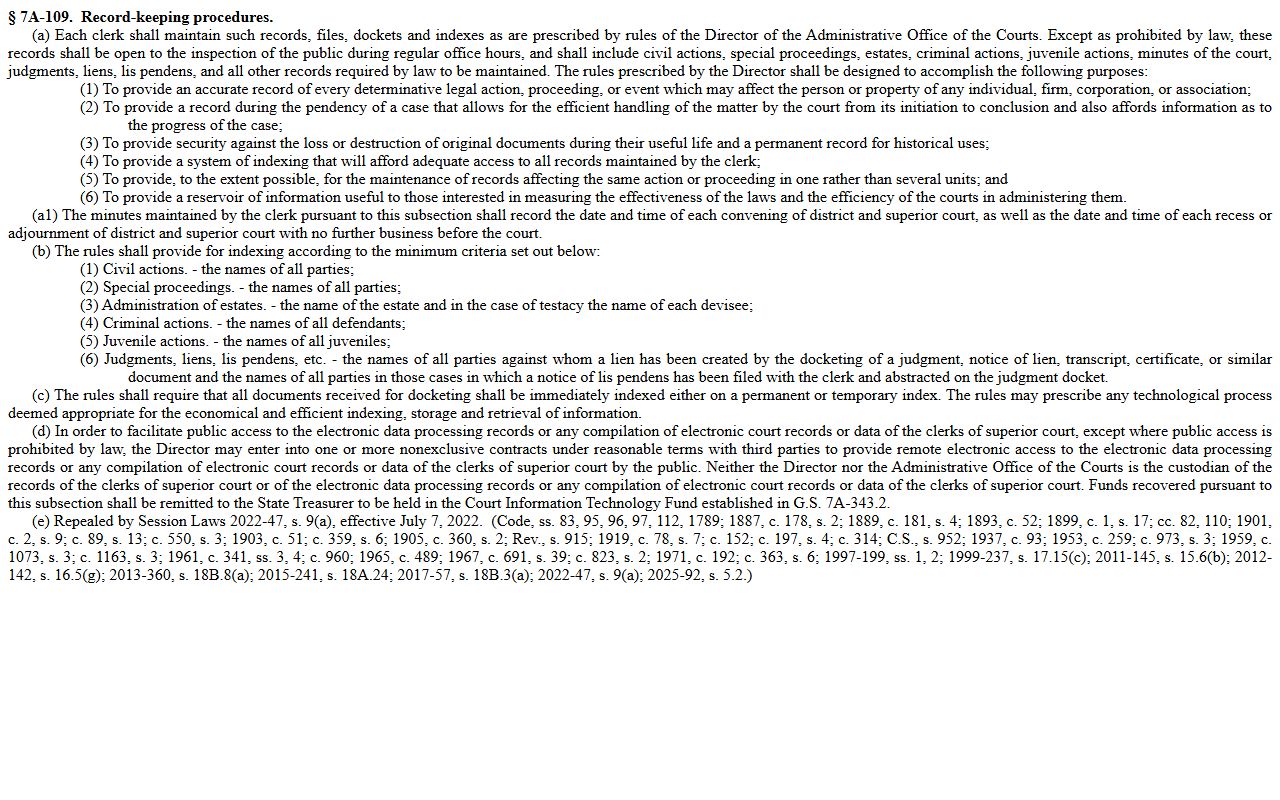
The statute is central to Polk County criminal court records because it addresses clerk records, files, dockets, and indexes.
Charges vs Convictions
A charge is an accusation filed into the court process. A conviction is the result of a guilty plea, verdict, or other finding of guilt or responsibility. Polk County criminal court records can show charges that were amended, reduced, dismissed, or resolved without conviction. Do not read a charge list as proof that every allegation became a conviction.
| Point | Charge | Conviction |
|---|---|---|
| Meaning | An offense allegation filed or carried into court. | A final guilt or responsibility outcome. |
| Timing | Appears early in the criminal case. | Appears after plea, verdict, or judgment. |
| Record Risk | Can remain visible unless dismissed records are expunged or restricted. | Can affect sentence, probation, fines, and future record consequences. |
| Best Field to Check | Charge description, count, statute, and status. | Disposition, judgment, sentence, and probation terms. |
Polk Criminal Prosecution Records
The official District Attorney page for Prosecutorial District 42 names Andrew Murray as District Attorney. Prosecutors decide whether to proceed with charges, dismiss charges, seek indictment, negotiate pleas, and handle many traffic reductions or dismissals. The DA is not the records custodian for public court files, but prosecution decisions often explain why a charge status changes in the court record.
Some Polk County criminal matters also connect to law enforcement records. Sheriff arrest search, incident search, inmate confinements, and the Citizen Connect app may show the arrest or custody side. Those records are different from the criminal court record, which is the clerk-held court file and docket. State prison, probation, and parole records are searched through the North Carolina Department of Adult Correction, not the Polk County court docket.
Access to Polk Criminal Records
Public access to Polk County criminal court records is based on court recordkeeping rules and public records law, with important limits. Chapter 132 defines North Carolina public records broadly. G.S. 7A-109 makes clerk records, files, dockets, and indexes open to public inspection during regular office hours unless prohibited by law. Ordinary criminal case files are different from criminal investigation records.
Key point: A public court case record may be open while related investigative material remains restricted by law.
The image below is sourced from North Carolina Chapter 132 public records statutes, which frame public-record access for Polk County criminal court records.
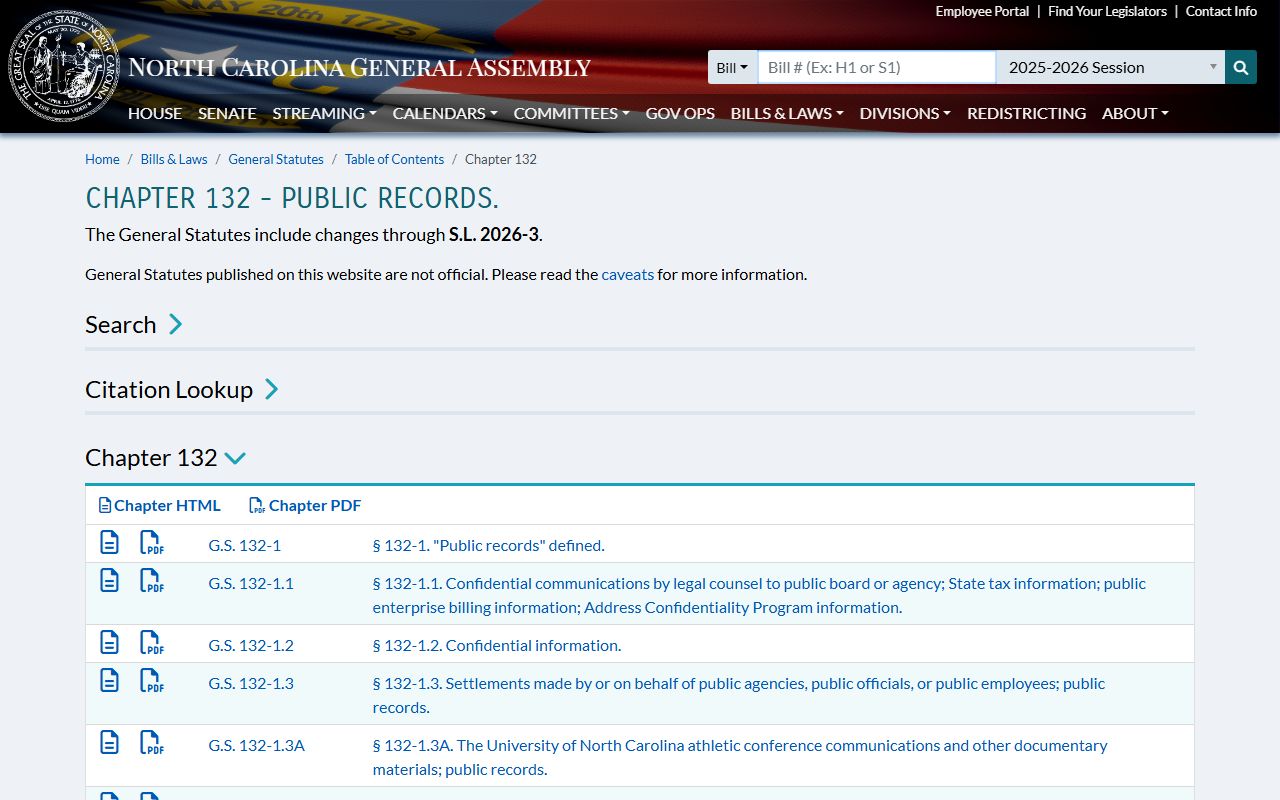
Chapter 132 access rules must be read with court-specific statutes, juvenile confidentiality rules, and investigation-record restrictions.
Sealed vs Expunged Records
Restricted criminal records require precise language. A sealed record still exists but is hidden from ordinary public access by law or court order. An expunged record is removed from public access after the statutory process and a court order. Public Portal results should not be treated as a complete view of sealed or expunged matters. Juvenile records are also generally confidential under Chapter 7B rules and should not be searched as adult criminal records.
| Point | Sealed | Expunged |
|---|---|---|
| Public Visibility | Restricted from ordinary public viewing. | Removed from public access after order and processing. |
| Record Existence | The file may still exist with limited access. | The public record is treated under expunction law after entry of the order. |
| Polk Filing Route | Usually depends on court order, statute, or case type. | Use NC Judicial Branch expunction forms and file through the required clerk route. |
| Eligibility | Depends on the record type and legal basis for sealing. | Depends on charge, disposition, class, waiting period, prior record, and exclusions. |
The image below is sourced from G.S. 15A-145.5, a North Carolina expunction statute for certain nonviolent offenses.
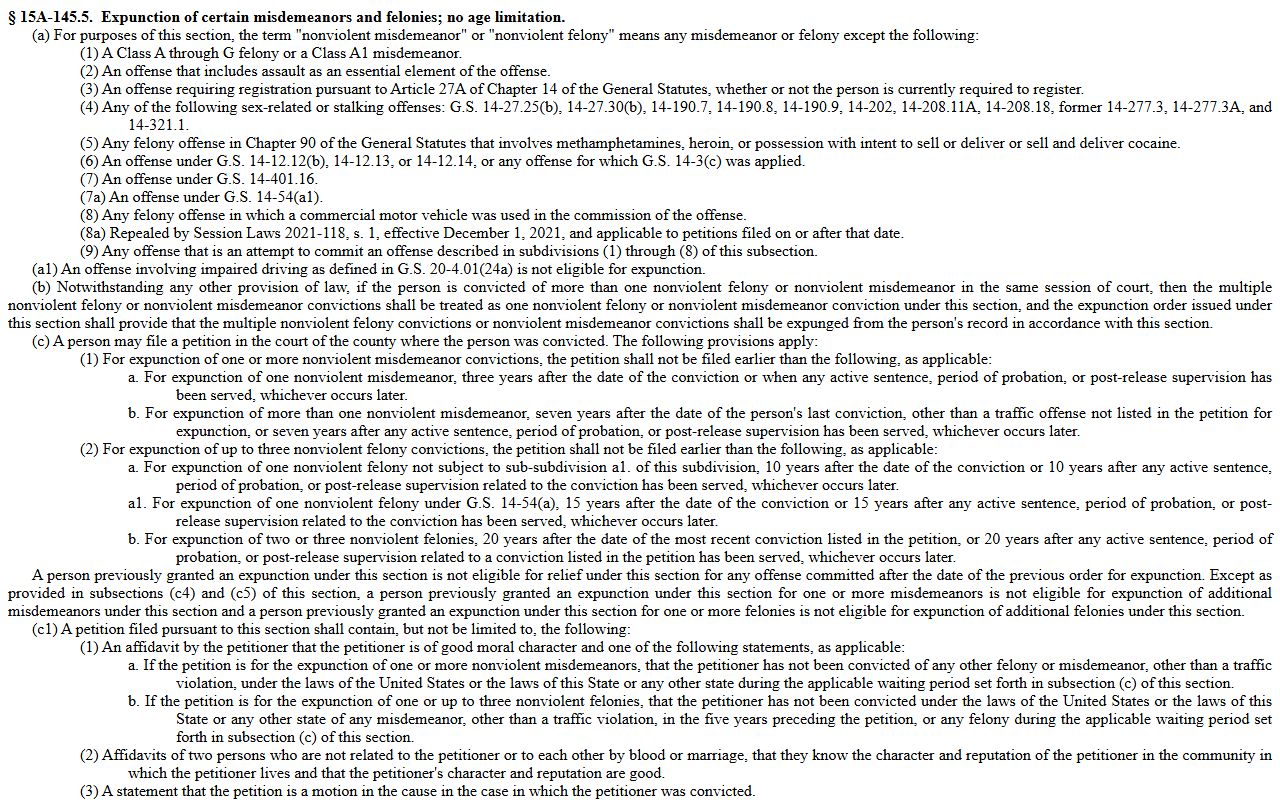
The statute image supports the page's warning that expunction eligibility is charge-specific and cannot be decided from a search result alone.
Restricted Polk Criminal Records
Several criminal-related records may be limited. Juvenile delinquency files are generally confidential. Search warrants and investigative records can be restricted, especially under G.S. 132-1.4. Sealed and expunged matters should not appear as ordinary public records. Mental health, protected victim information, minor names, Social Security numbers, financial account numbers, and protected addresses may be redacted or withheld.
For a complete Polk County criminal court record, identify the case number, confirm the disposition, and contact the Clerk of Superior Court for copy options. For custody status, use the jail or inmate route. For active warrant questions, use the Sheriff, magistrate, clerk, or attorney route rather than a third-party list.